The shape of the machine
Start with what exists. There is a trust. The trust owns bitcoin — nothing else of substance, just coins and a small cash balance. A sponsor administers it, an independent custodian holds the coins in cold storage, an administrator strikes the valuation, and a transfer agent keeps the share register. Against the bitcoin, the trust has issued shares, and those shares trade on Nasdaq, NYSE Arca or Cboe BZX under the exchange rules for Commodity-Based Trust Shares. If you are hazy on what that legal wrapper means, the definition page covers it; this page is about the moving parts.
Two prices exist at once and it matters that you keep them apart. The first is net asset value: the trust's bitcoin plus cash, less accrued fees, divided by shares outstanding, struck once a day against a published reference rate. The second is the market price of the shares, which is whatever buyers and sellers agree on second by second during the session. Nothing in law compels them to match. They match anyway, almost always within a few basis points, and the reason is the loop described below.
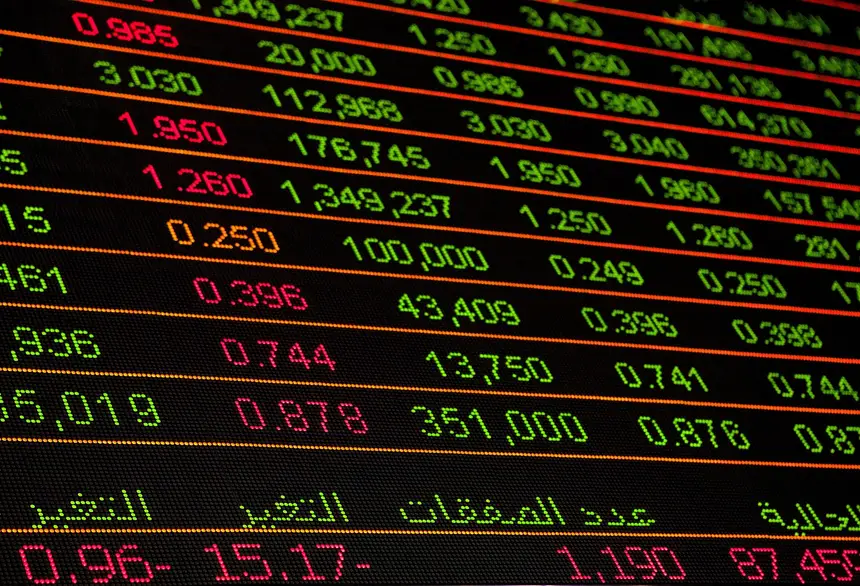 Two prices, one asset
 The loop that holds the price to NAV
Suppose demand for a fund runs hot one morning and its shares change hands at a price about a tenth of a percent above what the underlying bitcoin is worth. A large trading firm notices. It buys bitcoin on the open market — or takes coin it already holds — and delivers it to the trust. In exchange, the trust issues that firm a block of brand-new shares, called a creation unit, priced at net asset value. The firm now holds shares it obtained at NAV in a market where shares are trading above NAV. So it sells them. That selling is the whole point: it adds supply, the premium narrows, and the firm books the difference. It keeps doing this until the gap is too small to bother with, which is precisely when the price is back on NAV.
Run the film backwards and you have redemption. If the shares slip below NAV — a nervous afternoon, a wave of selling, a fund nobody is watching — the same firm buys cheap shares on the exchange, bundles them into a creation unit and hands them back to the trust. The trust cancels the shares and releases the corresponding bitcoin, or its cash equivalent, which is worth more than the firm paid for the shares. That buying supports the share price, and the discount closes. In both directions the correction is a by-product. Nobody is defending NAV out of duty. They are picking up money that the market left on the floor, and the price alignment is what happens on the way.
Hold on to the consequence of that, because it is the single most useful thing on this page: the mechanism is voluntary. No authorised participant is contractually obliged to create or redeem, ever. They act when the spread covers their costs — the bitcoin they must buy, the exchange fees, the balance-sheet capital, the risk of the price moving while the trade settles. In a fund with a dozen active participants and fifty million shares changing hands a day, that threshold is tiny and the correction is close to instantaneous. In a fund with a handful of participants and thin volume, the threshold is much higher, the gap has to get wider before anyone bothers, and the fund drifts. This is why liquidity is not a nice-to-have. It is the thing that makes the product work as advertised.
What we would actually watch
Forget premium and discount as a headline number and look at how quickly they close. A fund that occasionally prints a 0.15% premium and is back on NAV within minutes is functioning exactly as designed. A fund that sits at a persistent discount for days has an arbitrage problem, and the usual cause is that not enough participants find it worth their time. The observable proxy is the bid-ask spread: roughly 0.02% to 0.03% at the largest funds against about 0.11% at the smallest we track. That spread is the market pricing the difficulty of the loop.
Who is allowed to do this
Only authorised participants — large broker-dealers that have signed an agreement with the trust. They deal in creation units, blocks typically running to tens of thousands of shares, which is why no retail investor has ever redeemed ETF shares for bitcoin and why nobody ever will. You buy and sell on the exchange, at market prices, from whoever is on the other side. The AP relationship is a wholesale channel that sits behind the market you can see.
The names repeat across the category. Jane Street, Virtu Americas and Macquarie appear on every spot bitcoin fund whose filings name its participants; ABN AMRO Clearing appears on nearly all of them. The largest fund lists thirteen. Some of the smaller funds list four or five. That difference is not cosmetic — it is the difference between a market with several firms competing to close a gap and one where a single desk deciding to sit out the afternoon is enough to widen it. We publish the full lists, taken from the funds' own EDGAR filings rather than from aggregators, on the issuers, custodians and APs page.
No creation units, no market hours.Buying bitcoin on an exchange skips the entire wholesale apparatus — you are the buyer, the coin lands in your account, and you can withdraw it whenever you like.
Buy cryptoCash versus in-kind, and why it took eighteen months
When the SEC approved these funds in January 2024, it approved them cash-only. Release 34-99306 was explicit about it: footnote 77 recorded that the proposals contemplated only cash creation and redemption by authorised participants, and that in-kind transactions were outside the scope of the order. So for the first year and a half, an AP wanting to create shares wired dollars, and the trust itself went out and bought the bitcoin.
That sounds like a detail. It was not. It meant the fund was a forced buyer and a forced seller in the spot market on exactly the days when everyone else was buying or selling too, wearing the transaction costs and the slippage, and passing them through to shareholders. It added an execution leg that the AP could not manage or hedge, so the AP priced that uncertainty into its quotes. The result showed up where you would expect: wider spreads, and more tracking error than the structure needed to have.
The SEC changed it on 29 July 2025 in Release 34-103571, approving rule changes across Nasdaq, Cboe BZX and NYSE Arca that permit in-kind creations and redemptions for crypto ETPs. Now an AP can simply deliver bitcoin and receive shares, or deliver shares and receive bitcoin. The trust stops being a market participant on its own account. The execution risk moves to the firm best equipped to manage it, and the saving lands in the spread.
What changed between the two regimes
| What happens | Cash creation | In-kind creation |
|---|---|---|
| The AP delivers | Dollars | Bitcoin |
| Who buys the coin | The trust, on the open market | Nobody — the coin is already there |
| Who wears the slippage | Shareholders, through the trust | The AP, which prices it into its quote |
| Effect on the quoted spread | Wider, because execution risk is unhedged | Tighter, because the AP controls the leg |
Is any of this real, or is it a rule change nobody uses? It is real, and the numbers are in the filings. BlackRock's FY2025 annual report for IBIT records $5.76bn of bitcoin purchased in-kind for shares issued, and $845m of bitcoin paid in-kind for redemptions. That is not a pilot programme. But it is also not universal, and here the constraint is practical rather than legal: an in-kind AP needs an affiliate that can actually hold bitcoin, which most broker-dealers are not set up to do. Of IBIT's thirteen authorised participants, the filing names only four with executed in-kind agreements — Jane Street, Virtu Americas, JP Morgan Securities and Marex. The other nine still transact in cash.
There is one more wrinkle worth knowing because almost nobody reports it. Grayscale's GBTC remains cash-only. It was not covered by the in-kind order and no separate order has followed, so its filings continue to state that authorised participants may submit cash orders only. Meanwhile Grayscale's own Mini Trust, holding the same asset under the same sponsor, does offer in-kind. Two funds from one house, two different mechanisms.
Do not overstate the tax angle
You will read that in-kind creation makes these funds "tax efficient" the way it does for a conventional equity ETF. Be careful. That benefit exists because a 1940 Act fund can push appreciated securities out of the portfolio without realising gains at the fund level. A grantor trust has no fund-level tax to begin with — holders are treated as owning the bitcoin directly. So the classic in-kind tax advantage largely does not apply here. The real gains from the July 2025 change are cost and spread, and those are worth having on their own. Our tax guide sets out what does and does not pass through to you.
Where the bitcoin actually sits
Every one of the twelve active US spot funds holds bitcoin directly with a qualified custodian. Not through another fund, not through futures. The coins sit in cold storage — private keys generated and kept on hardware that has never touched a network — with the custodian's own controls, insurance arrangements and audit trail, legally separate from the sponsor's balance sheet. The trust's holdings are reported in its 10-K and 10-Q, so the coin count is a public number you can check rather than a claim you have to take on trust.
The uncomfortable fact is concentration. Roughly 80.8% of all ETF-held bitcoin sits with a single firm, Coinbase Custody Trust Company. It is worth being precise about why that is not the scandal it is sometimes made out to be, and also why it is not nothing. Coinbase Custody is a New York-chartered limited-purpose trust company that has been custodying institutional crypto for years, and at the scale these funds operate — hundreds of thousands of coins — the list of firms that can credibly do the job is genuinely short. Concentration here is an artefact of a young industry, not of carelessness. But it is still a shared dependency across most of the category, and an operational failure at one firm would be felt by holders of many funds at once. That is a risk you should know you are carrying, not one you should panic about.
Two funds are structured differently and both are instructive. Fidelity's FBTC self-custodies through Fidelity Digital Assets, an affiliate of its own sponsor. That eliminates the Coinbase dependency entirely and replaces it with a different question — whether you would rather custody were independent of the sponsor. ARK 21Shares' ARKB goes the other way and splits its holdings across three custodians: Anchorage Digital Bank, BitGo and Coinbase Custody. It is the most direct structural answer to concentration available in the category. Everyone else, broadly, uses Coinbase Custody, sometimes with a second custodian named in the filings but not currently used. The fund-by-fund detail is on the issuers and custodians page, and we treat custody as a risk category in its own right in what can go wrong.
The fee is paid in bitcoin, and you can see it in the share
Here is the mechanism that trips people up. A spot bitcoin trust holds almost no cash, so it cannot pay its sponsor fee out of a cash balance the way an equity fund does. It pays in bitcoin. The fee accrues daily against net assets, and periodically the trust delivers or sells a small quantity of coin to settle it. The coin count goes down; the share count does not.
The consequence is that the bitcoin behind each share falls a little every single day, permanently and by design. If a fund launched at 0.0005 bitcoin per share, after a year at 0.25% it holds roughly 0.25% less coin per share, and after ten years the compounding has taken a real bite. Nothing has gone wrong. That erosion is the fee. It is also why coin-per-share is the most honest number to compare across funds over time, and why the gap between a fund at 0.14% and one at 1.50% is not a rounding difference — it is roughly ten times the rate of erosion on identical exposure. We run the numbers on the fees and expense ratios page.
One small tax consequence follows from the same mechanism, and it surprises people who have never traded a share all year. Because a grantor trust passes through to holders, each delivery or sale of bitcoin to pay the sponsor fee is a taxable disposition attributed to shareholders. The amounts are small. They are also unavoidable, and they arrive whether you traded or not.
Tracking difference is not the expense ratio
The last piece of vocabulary. Tracking difference is the gap between what the fund returned over a period and what bitcoin returned over the same period. People assume it equals the expense ratio. It does not, and treating them as the same is how you end up choosing the wrong fund.
The fee is the largest and most predictable component, but three other things feed in. There is the cost of the trust's own trading, which under cash creation could be significant and which in-kind has substantially reduced. There is cash drag — the small idle balance a trust carries for expenses, which earns nothing like bitcoin's return in a rising market. And there is the reference rate the fund prices against, since different funds strike NAV against different benchmarks at slightly different times of day, which produces small but persistent discrepancies over a year. Add them up and a fund can trail bitcoin by noticeably more than its headline fee. Third-party data on the category shows exactly that pattern: the largest funds track within a few basis points of their stated cost, while some smaller ones have historically carried a much wider gap despite an attractive fee on paper.
Which brings the mechanism full circle. Tracking depends on the arbitrage loop running cheaply, the loop runs cheaply when authorised participants compete, and they compete where there is volume. Everything on this page is really one argument: in this category, size and liquidity are not vanity metrics. They are the structural reason a fund does what it says.
Mechanism questions, answered properly
How does a Bitcoin ETF keep its price in line with bitcoin?
Can I redeem my ETF shares for actual bitcoin?
Who holds the bitcoin in a Bitcoin ETF?
What changed when the SEC allowed in-kind creations?
Why does the bitcoin per share keep falling?
The wholesale machinery exists so you never have to touch the coin. Some people want to touch the coin.
If the appeal of bitcoin is that you can hold it yourself, an exchange account gets you there in minutes — no creation units, no authorised participants, no sponsor taking a slice each year.
A venue operating since 2013 — registered with FinCEN and holding state money transmitter licences in 38 states and the District of Columbia.