What matters, and what does not
- Commission is a solved problem. US-listed ETFs trade commission-free at every major US broker, and have since 2019. It is not a differentiator.
- Fractional ETF support is. Fidelity, Interactive Brokers, Robinhood, Webull, Public and SoFi have it. Schwab, Vanguard, Merrill, E*TRADE and Chase Self-Directed do not.
- Schwab's Stock Slices excludes ETFs. It covers S&P 500 stocks only — an under-reported constraint for anyone buying a fixed amount monthly.
- Morgan Stanley opened the wirehouse door in August 2024, letting its advisors actively solicit these funds for the first time.
- Europe is a different market. PRIIPs blocks US-listed spot Bitcoin ETFs from EU and UK retail investors entirely.
The comparison at a glance
A caution before the table. Commission structures and fractional policies are durable positions that brokers announce and rarely reverse quietly, and that is what this table records. It does not attempt to quote live per-share pricing for Interactive Brokers' Pro tier or per-contract options rates, which change and are better read from the broker's own schedule. Treat the commission column as "there is no ETF commission here", which is the useful fact, rather than as a price quote.
US brokers that carry spot Bitcoin ETFs
Interface verdicts are our own assessment of the platform experience.
| Broker | ETF commission | Fractional ETFs | IRA | Options | Interface verdict |
|---|---|---|---|---|---|
| Fidelity | $0 online US ETFs | Yes | Yes | Yes | Best research stack; sprawling legacy navigation |
| Charles Schwab | $0 | No — stocks only | Yes | Yes | Two platforms that feel like two companies |
| Vanguard | $0 | No | Yes | Confirm | Weakest trading experience among the majors |
| Interactive Brokers | $0 on IBKR Lite | Yes | Yes | Yes | Most capable and most hostile |
| Robinhood | $0 | Yes | Yes, with match | Yes | Best order ticket, most criticised UI |
| E*TRADE | $0 | No | Yes | Yes | Power E*TRADE is strong; the split is not |
| Merrill Edge | $0 | No | Yes | Yes | Good research in a poor container |
| Chase Self-Directed | $0 | No | Yes | Yes | Three taps from your checking balance |
| Webull | $0 | Yes | Yes | Yes | Best free charting; dense to the point of clutter |
| Public.com | $0 | Yes | Yes | Yes | Well designed; the social feed is a risk |
| SoFi Invest | $0 | Yes | Yes | Yes | Beginner-friendly, shallow after year one |
Fractional shares: the differentiator nobody puts in the headline
If you take one thing from this page, take this. Spot Bitcoin ETF share prices are not trivial amounts, and they rise with bitcoin. Someone investing $200 a month into a fund whose shares cost a meaningful fraction of that is materially affected by whether their broker will sell them a partial share. On a fractional platform the whole $200 goes to work on the day it arrives. On a whole-share platform a remainder sits in cash until the next contribution happens to round it up, month after month.
Schwab's exclusion of ETFs from Stock Slices is the single most under-reported fact in this comparison. Stock Slices is well known and well marketed, and a great many people assume it applies to funds. It does not — it covers S&P 500 stocks. If you have chosen Schwab specifically so you can dollar-cost average into IBIT or FBTC in small amounts, you have chosen the wrong platform for that job, and nothing in Schwab's marketing will tell you so.
Vanguard, Merrill Edge, E*TRADE and Chase Self-Directed are in the same position. E*TRADE supports fractional quantities through dividend reinvestment but not as a way to place a purchase. On the other side, Fidelity's fractional trading extends to ETFs with a very low minimum, and Interactive Brokers, Robinhood, Webull, Public and SoFi all support fractional ETF orders too. If you contribute monthly, that list is your shortlist and the rest of this page is secondary.
One trade-off comes attached: many brokers execute fractional orders as market orders only. That is a real constraint if you have read our argument for using limits — we work through it in the order types guide.
 The thing you live with
 Platform by platform
Fees are identical, the funds are identical, so this is where the argument actually lives. Each verdict below names what the platform is genuinely good at and what is genuinely wrong with it, because both are true of every one of them.
Fidelity
The strongest research stack in US retail brokerage: independent analyst reports, a capable ETF screener and clear, honest fund pages. It supports fractional ETF trading, which puts it on the shortlist for regular contributions, and Active Trader Pro is a competent desktop platform for people who want one. Fidelity also issues its own fund, FBTC — notable because it is the only spot Bitcoin ETF whose custodian is an affiliate of its sponsor rather than Coinbase Custody.
The weakness is the information architecture. Fidelity's site has accumulated layers over decades, and there are frequently three routes to the same task, each looking as though it belongs to a different era of the internet. Newcomers get lost in account navigation. The visual design is dated. Mobile trails the web experience on features. None of this is fatal — it is friction, and it is the price of the deepest research on the list.
Charles Schwab
Schwab has a split personality and it is the defining fact about using it. thinkorswim is one of the strongest retail platforms in existence for charting and options — genuinely excellent, with a steep learning curve to match. schwab.com is a competent, unremarkable brokerage site. They are completely separate applications, and moving between them feels like moving between companies.
For someone buying a Bitcoin ETF and holding it, schwab.com is fine and thinkorswim is irrelevant. For an active trader, thinkorswim is a strong reason to be here. For someone in between, the split is a permanent low-grade annoyance. And the fractional problem stands: Stock Slices does not cover ETFs, which for small regular buys is a real limitation rather than a quibble.
Interactive Brokers
The most capable and the most hostile platform on this list, and both halves are meant seriously. Trader Workstation gives you order types, routing control and global market access that nothing else here approaches — including access to the non-US listings covered on our global Bitcoin ETF page, which most US brokers simply do not carry. Fractional ETF trading is supported. IBKR Lite removes commission on US ETFs entirely.
The friction is real and worth naming. Account opening is long and document-heavy. The terminology throughout assumes you already know what you are doing. The defaults are not beginner-safe, and TWS presents a genuinely intimidating first screen. What is less well known is that the web Client Portal and the GlobalTrader mobile app are much better than TWS's reputation suggests — a buy-and-hold investor can use Interactive Brokers happily and never open TWS at all.
Robinhood
The fastest onboarding and the cleanest order ticket in the industry. That is not in dispute and it is exactly why Robinhood keeps winning new investors: the distance between deciding to buy something and having bought it is shorter here than anywhere else, and the ticket itself is a small piece of interface design that other brokers should study. Fractional trading is supported, the IRA comes with a contribution match, and Robinhood Legend arrived in 2024 for people who want a desktop platform.
The criticisms are also real and must be named. Research and screening are thin — you will not do your fund selection here. The interface has been credibly criticised for gamifying trading, and the same frictionlessness that makes the ticket a pleasure makes overtrading easy. The business runs on payment for order flow. Customer service was historically poor and has been improving. Robinhood also acquired Bitstamp, which closed in 2025.
Chase Self-Directed
The value proposition is a single sentence: it lives inside the Chase app, so your brokerage account is three taps from your checking balance. For a large number of people that is worth more than any feature. Money moves instantly, there is one login, and the whole thing is already on your phone.
It is also the thinnest toolset here by a distance. Minimal screening, minimal research, no serious charting, no fractional ETF trading. This is a place to execute a decision you made somewhere else — which, to be fair, is exactly what a lot of Bitcoin ETF purchases are. Just do not expect to research the fund inside it.
Merrill Edge
High research quality in a poor container. The Bank of America integration is the actual point — one login across banking and brokerage, and Preferred Rewards tiers that pay real benefits if your balances qualify. The research available to Merrill clients is genuinely strong.
The trading experience does not match it. Layouts are dated, the MarketPro platform is clunky, and the mobile trading flow is weak. There is no fractional ETF trading. Merrill has also historically restricted advisor solicitation of these funds to unsolicited orders, which matters if you are working with an advisor rather than self-directing.
E*TRADE
Power E*TRADE is genuinely good, particularly for options — the chain display and the risk visualisation are among the best available outside thinkorswim. If you intend to write covered calls against a Bitcoin ETF position, and IBIT's options market has been the deepest in the category since it opened in November 2024, this is a serious platform for it.
The classic E*TRADE experience sits alongside Power E*TRADE and produces the same two-platform confusion Schwab has. No fractional ETF purchases either — dividend reinvestment only. E*TRADE is now part of Morgan Stanley, which is the same group that launched MSBT, the cheapest fund in the category at 0.14%.
Webull, Public and SoFi
Three smaller platforms that all support fractional ETF trading and all deserve a sentence of honesty. Webull offers the best free charting on a mobile app, level-2 data and a strong screener — it punches well above its price. Its research is thin and largely aggregated, the interface is dense to the point of clutter, and support is a common complaint. Public.com is modern, mobile-first, well designed and unusually transparent about its own payment-for-order-flow economics, with a strong Treasury and bond offering; it is less analytically deep, and the social feed is a genuine behavioural risk for inexperienced investors. SoFi Invest is clean and beginner-friendly, tightly bundled with banking and lending, and gets shallow once you are past your first year, with persistent cross-sell throughout.
What we would actually watch
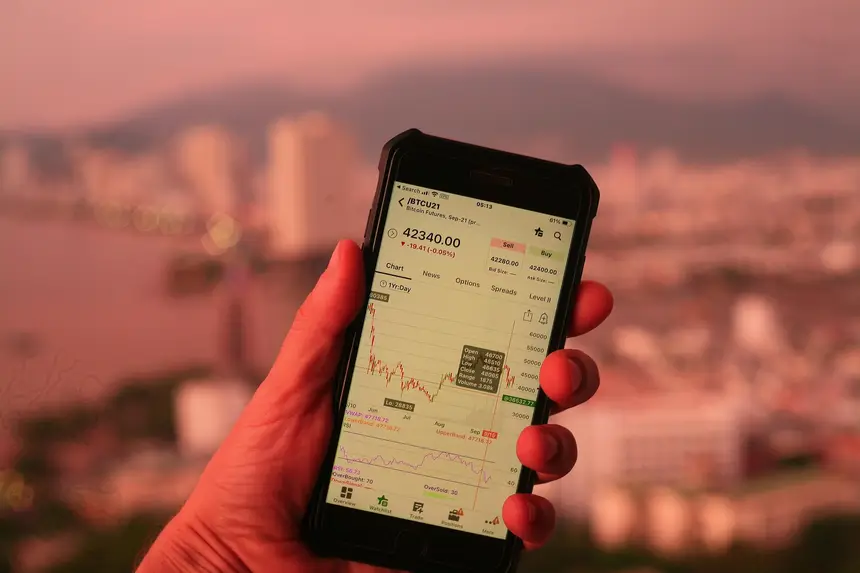
The interface is not a soft factor — it is the factor that decides whether you follow your own plan. A platform that makes buying feel like a game will get you to trade more than you intended. A platform where the order ticket takes six clicks will quietly discourage you from using a limit order, because the market button is the fast one. A platform that cannot sell you a fractional share will leave part of every contribution in cash. None of that shows up in a fee comparison, and all of it compounds. Choose the platform whose defaults push you towards the behaviour you say you want.
Comparing brokers because you want the asset, not the wrapper?If what you actually want is bitcoin you can withdraw, hold and send, none of these platforms will give you that — they sell you a share in a trust. An exchange account gives you the coin.
Compare and buyThe advisor channel, and the door Morgan Stanley opened
For the first seven months these funds existed, the largest pools of US retail money could not be pointed at them. Wirehouse advisors could execute an unsolicited order if a client insisted, but they could not raise the subject. That is a meaningful constraint on where tens of billions of dollars go.
Morgan Stanley became the first US wirehouse to change it, in August 2024, allowing its roughly 15,000 advisors to actively solicit spot Bitcoin ETFs. The initial permission covered IBIT and FBTC only. It was gated on a client net-worth threshold, on an aggressive risk rating, and on taxable accounts only, with ongoing concentration monitoring — the specific thresholds were reported at the time rather than published by the firm, and we have not been able to confirm them from a primary source, so treat any exact figure you read as reported rather than confirmed. Whether the policy has since expanded to retirement accounts is likewise unconfirmed.
The template mattered more than the detail. Every other wirehouse that followed used a recognisably similar structure: a named short list of funds, a suitability gate, a concentration cap. Wells Fargo offered spot Bitcoin ETFs on an unsolicited basis from 2024, and we cannot confirm any change to that. Merrill's historical position was the same. If you are working with an advisor rather than self-directing, the question to ask is not whether the firm allows these funds but whether your advisor may raise them, and which specific tickers are on the approved list.
The Vanguard question
Vanguard is the one broker whose availability people still ask about, and the answer needs care. Vanguard refused to offer spot crypto exchange-traded products from January 2024 — blocking purchases while allowing existing holders to sell — and reversed that policy in 2025 under new leadership. Confirm the current scope with Vanguard directly before you rely on it, because we cannot verify the precise terms from a primary source. Vanguard still sponsors no crypto product of its own.
Separately from the policy: Vanguard is the weakest trading experience among the majors, and that is worth saying plainly. The order ticket is a slow multi-step flow. The screener is rudimentary. Research is thin. The mobile app was clearly built for someone checking a balance rather than placing a considered trade. Vanguard is excellent at what it was designed for — buying index funds twice a year and never looking again — and unpleasant for a deliberate ETF order where you care about the limit price. There is no fractional ETF trading either.
Europe, and why the answer is completely different
Everything above assumes a US investor, because the US products only exist for US investors. EU and UK retail investors generally cannot buy US-listed spot Bitcoin ETFs at all. This is not conservatism on the part of any particular broker. It is PRIIPs: a packaged retail investment product distributed in the EU or the UK must have a Key Information Document, US ETFs do not publish one, and so European brokers are not permitted to distribute them to retail clients. Changing platform does not change this.
What Europeans buy instead is a physically-backed exchange-traded product listed on Xetra, SIX or Euronext. Three platforms come up most often. Trade Republic, the German neobroker, charges a flat external execution fee per trade and carries European crypto ETPs alongside direct crypto — it cannot offer the US funds. Revolut handles crypto in-app, with fees that vary materially by subscription tier and a spread that is not always obvious inside the buy flow. eToro charges no commission on stocks and ETFs but bills foreign exchange separately, and its US crypto offering has been restricted to bitcoin, bitcoin cash and ether since a September 2024 SEC settlement; copy-trading is its differentiator and its main risk. The global listings page covers the products themselves, including the PFIC problem a US person inherits by holding one.
 Different rules, different products
 How to choose: match the platform to your behaviour
Almost every broker comparison ends with a feature matrix and lets you infer that more features is better. It is not. The right platform is the one whose defaults match how you actually behave, and the honest way to choose is to describe your own behaviour first.
If you contribute a fixed amount every month, fractional support outranks everything else. Fidelity, Interactive Brokers, Robinhood, Webull, Public and SoFi are the list. Everything else is a compromise you will pay for monthly, forever.
If you research before you buy, Fidelity is the strongest answer despite the clumsy navigation, and Merrill is a reasonable second if you already bank with Bank of America. Do not choose Robinhood or Chase Self-Directed as your research environment; use them to execute a decision made elsewhere.
If you know you overtrade, be honest about it and pick friction deliberately. The platform that makes buying feel effortless is not doing you a favour. Vanguard's slow order ticket, which is a genuine weakness for most purposes, is arguably a feature for someone who cannot stop fiddling with a position.
If you will write options against the position, the shortlist narrows to thinkorswim, Power E*TRADE, Interactive Brokers and Fidelity's Active Trader Pro, and IBIT is the only fund with a genuinely deep chain — the detail is on the IBIT fund page. If you want to trade non-US listings, Interactive Brokers is close to the only realistic answer.
With the platform decided, the remaining decisions are which fund and how to place the order. The list of all twelve US spot funds is the starting point, the fee analysis settles the cost question, and the step-by-step buying guide covers the account type, the funding delay and the order itself. If you have not yet decided whether you want the fund at all, fund versus coin is the argument to read first.
Questions about brokers and platform access
Which broker is best for buying a Bitcoin ETF?
Does Robinhood offer Bitcoin ETFs?
Can I buy a Bitcoin ETF through Interactive Brokers?
Why can I not buy a US Bitcoin ETF from Europe?
Does my broker charge extra to trade a Bitcoin ETF?
No broker on this page will hand you the coin
Every platform here sells you a share in a trust that holds bitcoin on your behalf, tradeable only when the US market is open. Buying the asset directly is a different transaction with a different set of trade-offs.
A regulated venue operating since 2013 — FinCEN-registered, with money transmitter licences across 38 states and DC.